“We’re not here simply to sell cars, we’re here to bring a better EV solution to customers,” says Mike Yang, General Manager of Geely Auto UK, speaking exclusively about the company’s long-term ambitions in Britain.
When Geely Auto UK confirmed plans last month to sell 100,000 vehicles a year and launch 10 new electric and plug-in hybrid models within three years, it signalled an ambitious Chinese entry into the UK’s electric vehicle (EV) market.
Go deeper with GlobalData


Access deeper industry intelligence
Experience unmatched clarity with a single platform that combines unique data, AI, and human expertise.
Yang acknowledges the UK’s maturity and competitiveness but insists there is still “great potential and opportunity for new energy vehicle brands.” Despite a crowded field, he says Geely sees space for growth driven by “government policy, infrastructure development, and evolving customer preferences.”
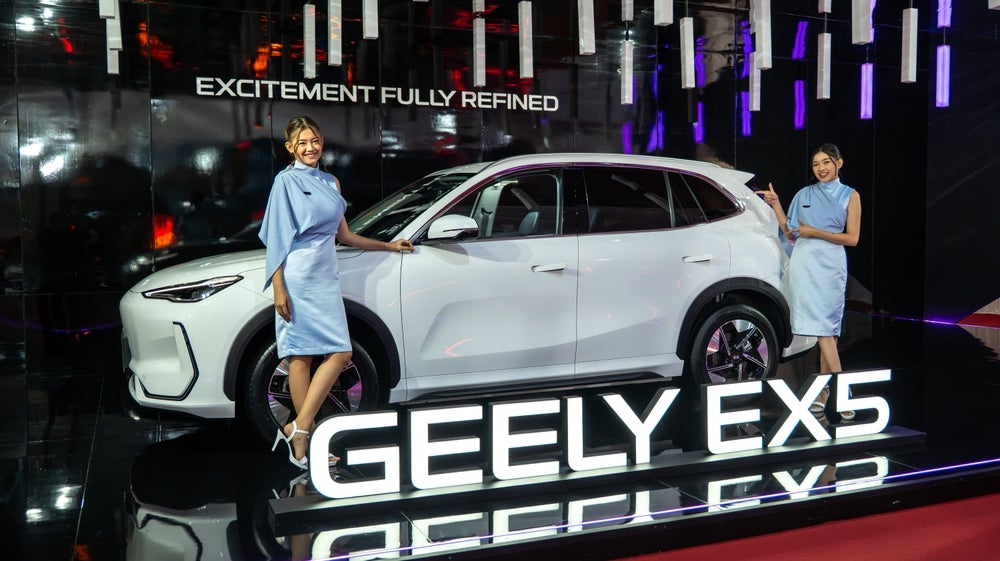
The company’s first model, the EX5 SUV, starts from £31,990, positioned against Tesla’s Model Y, with local hiring of around 300 staff already planned. And while imports will dominate initially, Yang says local production remains on the table, “if we find that local production has more of an advantage, we’re open to that.”
A widening gap
Geely’s arrival comes at a critical moment for the UK’s car industry. The government aims to produce 1.3 million vehicles annually by 2035, almost double the 755,000 units expected this year, according to the Society of Motor Manufacturers and Traders (SMMT).
SMMT Chief Executive Mike Hawes has warned that the UK must attract “at least one, if not two new entrants” if it is to meet production targets. Geely’s investment fits that brief, but also highlights the difficulty of sustaining large-scale automotive manufacturing in Britain.
US Tariffs are shifting - will you react or anticipate?
Don’t let policy changes catch you off guard. Stay proactive with real-time data and expert analysis.
By GlobalDataDespite active government lobbying, Chinese manufacturers have favoured other European bases. In Turkey, both BYD and Chery have announced $1 billion EV plants, taking advantage of tariff-free EU access via the customs union. Hungary hosts BYD’s first European passenger car factory, and Spain has drawn Chery and Leapmotor into joint ventures at former Nissan sites.
Domestic headwinds and fragile supply chains
The UK faces headwinds from high energy and labour costs and supply chain vulnerabilities. Nissan’s Sunderland plant, the country’s largest, is operating below capacity amid global restructuring. Meanwhile, Jaguar Land Rover (JLR) suspended production for more than a month after a cyberattack on 1 September, which reduced UK vehicle output by over a third in September alone.
Yang acknowledges the challenge. “It takes a long time to build a supply chain, but it’s very easy to destroy one,” he says. “Governments need to ensure stability and confidence for OEMs, because on the supply chain rests the efficiency, cost and quality of what we produce.”
Elsewhere in the Geely group, Lotus reversed plans to end UK manufacturing earlier this year but continues to explore partnerships to sustain its Hethel, Norfolk plant. Yang, who previously worked at LEVC, believes that both Lotus and LEVC’s advanced facilities could “definitely support local production if we need that in the future.”
Geely’s local partnerships and retail network
Geely’s strategy is anchored in building a local ecosystem. “From the beginning, I told my team we are not just here to introduce a Chinese model at a competitive price, our goal is to deliver an EV solution suited to UK conditions,” Yang says.
To that end, the company has built a series of partnerships:
- With Andersen EV, offering a co-branded home charger and a £1,000 contribution toward installation;
- With Octopus Electric Vehicles, providing customers with integrated leasing, charging and energy packages;
- And with CA Auto Finance UK, the exclusive finance partner, offering Personal Contract Purchase, Hire Purchase, Asset Protection Plan, Personal Contract Hire, and Business Contract Hire options, supported by dealer wholesale finance.
A new retail network underpins these partnerships. Geely Auto UK has 25 dealerships, with plans to reach 50 by the end of 2025 and 100 by 2026. Sixteen partners were confirmed at launch, including Sytner, Stoneacre, Glyn Hopkin and Hendy, alongside regional “local heroes” such as Lipscomb, Cars2, TMS and Furrows.
“We’ve combined national strength with local expertise, that mix allows us to grow responsibly while understanding customer preferences region by region,” Yang says.
Industrial exposure and policy risk
While Britain’s open trade policy has allowed a rapid influx of new EV brands, it also brings strategic risk. Unlike the EU, the UK has not imposed tariffs on Chinese-built EVs, a policy that has boosted consumer choice but increased dependence on overseas production.
The dilemma is becoming increasingly political. The UK government’s recent decision to abandon legal proceedings against two Britons accused of spying for China has reignited a fierce debate: does Britain still view China as a strategic trading partner, or as something more adversarial?
For the EV finance and leasing community, which is forming long-term partnerships with Chinese OEMs, this uncertainty presents a new layer of exposure.
Balancing opportunity and risk
The UK needs foreign investment to meet its decarbonisation and manufacturing goals, yet it must balance that openness with industrial resilience. As Geely, BYD, and Chery expand, Britain faces a fine equilibrium, remaining attractive to global investors while retaining strategic control over its future supply chains.
“If local production offers a better solution for our customers, we can turn that around faster than any other Chinese brand currently in the market,” Yang says confidently.
For now, Geely’s entry into the UK market represents both an opportunity and a warning: a test of whether Britain can maintain its appeal as an open destination for innovation, without leaving itself exposed in a shifting geopolitical landscape.