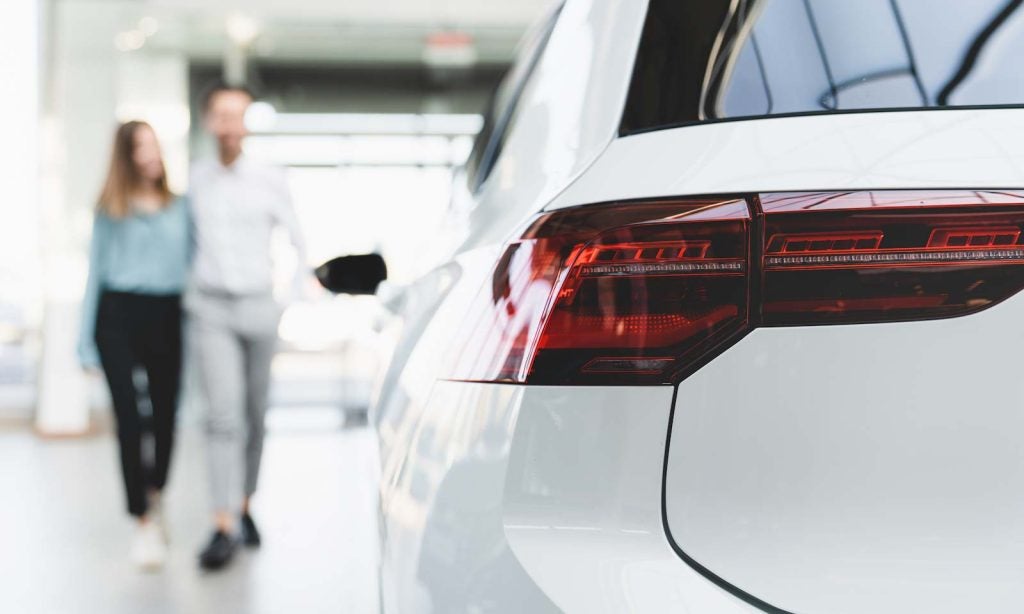

Chris Payne, business development manager at Opia, suggests a method for retaining customers that avoids the disappointment of a low trade-in offer
From multi-purpose vehicles to executive saloons, the automotive market is growing.
Go deeper with GlobalData


Access deeper industry intelligence
Experience unmatched clarity with a single platform that combines unique data, AI, and human expertise.
According to the Society of Motor Manufacturers and Traders, UK auto registrations hit almost 2.5 million in 2014, the best performance since 2004. This brings the number of cars bought in Britain back to pre-recession levels.
Yet, in what remains a highly-competitive market, manufacturers still need a powerful incentive to encourage existing buyers to
stay brand-loyal when upgrading to a new model.
When competition is so fierce, any sales tool that encourages customers to stick with the brand should be seized upon. However, for many consumers, the stumbling block comes when they discover how low the guaranteed future value-based trade-in price is for their vehicle at the end of their personal contract plans or credit deals.
The whole experience leaves them with a bad taste and all too frequently, they leave for another manufacturer or decide to sell privately and look elsewhere.
Keeping the customer
Of course, for manufacturers facing this constant breakage of brand-loyalty, the answer is not a simple matter of upping the price on offer to keep the customer. The costs of repairing, valeting, storing and selling the vehicle all stack up for their dealerships and leave little room for manoeuvre.
Nonetheless, when customers sit down and asks for the trade-in price, it’s clearly a crucial turning point in their relationship with a brand. Which is precisely where the kind of risk-managed promotional tools already used to great advantage in the consumer electronics sector have the edge over run-of-the-mill guaranteed future value offers.
A creative alternative to margin-eroding price-drops, these promotions give added value to consumers and are backed by data-driven analysis and mitigated for risk, bringing brands and retailers the opportunity to make headline offers that they could not otherwise afford.
They are undertaken through partnership with risk-managed sales promotions companies with established expertise. Being highly adaptable it’s time they were put to good use in the automotive sector.
For instance, a manufacturer could pay the sales promotion company a set percentage of the value of each car sold. Typically, this would be 1.5%, translating to £300 if we use the example of a £20,000 car.
When customers signs up for a conventional finance deal, they are told of the guaranteed future value at its end, typically underwritten by the dealer or the finance provider. However, in a package put together with the aid of a sales promotion specialist they would also be informed that they are entitled to an extra 10% if they stick with the brand.
So if the bank has guaranteed the future value of the £20,000 car at £10,000 after three years, the consumer is offered an extra £1,000 by the manufacturer if they choose their replacement from the same brand or within the same group.
Eliminating disappointment
This reduces consumers’ shock and disappointment at receiving a low trade-in price at the end of the deal, giving them an extra incentive to stick with the brand and the chance to obtain a price equivalent to what they might achieve from selling privately.
Even if the trade-in value offered by the dealer is higher than the original guaranteed future value, the promotion still operates and brings the consumer the extra 10% over the fair market appraisal.
If repeated throughout the life cycle of a customer’s car purchasing, such a scheme would more than pay for itself, with a new car bought from the same manufacturer or group at the end of each deal.
The risk is carried by the promotions company, which indemnifies itself against over-use, using its expertise and data analysis.
Ordinarily, the downside of not being able to predict how many customers will take up an offer is that the promotional risk drops like an unexploded bomb onto a firm’s balance sheet, waiting to go off if a promotion is more popular than anticipated.
Experts in risk-managed sales promotions, however, are able to use all their experience in the field and the data it generates to make effective predictions and to underwrite the offers.
They also enable the percentage of value on offer to be flexed according to how hard the manufacturer wants to drive the customer.
Since approximately three-quarters of all cars bought by private buyers in the UK are purchased with finance deals, such promotions should have substantial potential to boost customer-retention. Conventional guaranteed future value-based deals too often leave car buyers feeling deflated when they find out the trade-in price they are being offered.
Automotive manufacturers with multiple sub-brands need to use risk-managed promotions to capitalise on the wide choice they can give consumers wanting a change of model or an upgrade.
Not only do well thought-out offers of this type give the consumer more confidence in the resale value of the car when they first buy, they could also help the manufacturer gain more control over used vehicle resale prices.
They are also the kind of smart promotions that are set to make greater inroads into the UK retail motor industry. Having successfully rolled out a similar scheme in the US, electric car maker Tesla recently introduced a new bundle of finance deals to UK buyers.
Customers put down a 15% deposit on a Model S, for example, and then Tesla agrees to buy it back for 50% of the price at the end of the three-year finance deal. It will also buy 43% of the value of any extras bought by the consumer.
Interest rate offer
The customer also has the option of continuing to lease the car for another two to four years at the same interest rate. By offering these commitments, Tesla is clearly aiming to boost sales of the new vehicles and allay fears that the value of the Model S may plummet in quick time.
If a company such as Tesla is trying out these deals, it’s time manufacturers in Europe began to think more creatively about mechanisms that increase brand loyalty over a lifetime, not just the short-term.
Such promotional mechanisms will give car manufacturers far greater opportunities for customer-retention than traditional deals currently on offer on the forecourt.
Crucially, they will not have any detrimental impact on profit and loss accounts, and instead of leaving a sour taste, they will put smiles on the face of customers.