
Six major truck manufacturers – Scania, MAN, Volvo Trucks, Daimler, IVECO and Ford – have written to European Commissioners requesting a revision of the EU’s truck CO₂ Regulation, according to a letter seen by Transport & Environment (T&E).
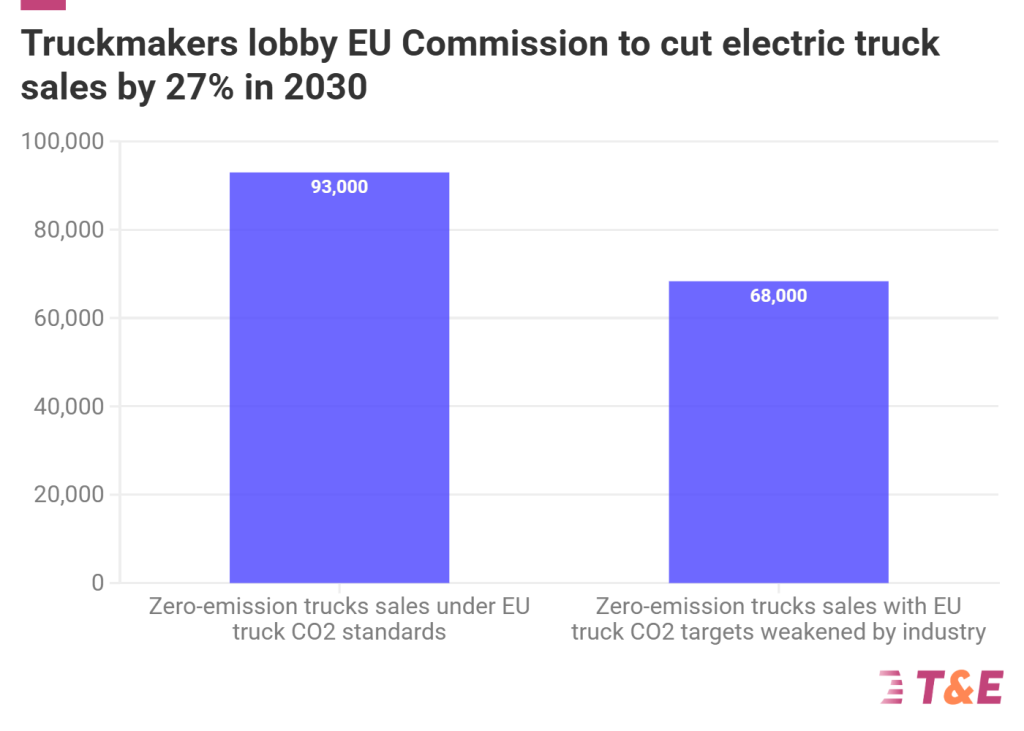
The companies have reportedly asked for an amendment that would allow them to generate emissions credits, effectively adjusting how targets for reducing emissions are calculated. According to T&E’s analysis, such a change could reduce the number of zero-emission trucks (ZETs) sold in 2030 by around 27 per cent.
Go deeper with GlobalData


Access deeper industry intelligence
Experience unmatched clarity with a single platform that combines unique data, AI, and human expertise.
T&E said the proposal “would undermine the ambition level” of the existing regulation and risk delaying the market shift towards zero-emission vehicles. The organisation’s freight and fleet director, Stef Cornelis, said truckmakers were presenting the proposal as “a small adjustment”, but argued that “it would mean a major rollback” of Europe’s decarbonisation plans.
Cornelis added that altering the targets could “create investment uncertainty” for companies building charging networks and grid capacity. “The trucking industry claims that lack of charging infrastructure is the main bottleneck,” he said, “but how do they expect a power company to invest if they are now rolling back on their own commitments?”
T&E’s modelling assumes OEM ramp up sales up to 2029 as usual to prepare for the 2030 -43% CO2 target, but then use the resulting windfall credits to ease compliance in 2030, 2031, and 2032. The credits banked in 2026–2028 are used in 2030, while the credits banked in 2031–32 are used in 2031 and 2032.
The group warned that any delay to the transition could increase competitive pressure from Chinese manufacturers, which are investing heavily in electric truck production.